Can’t Stop the Upside & Debunking Socialism Myths
Another huge rally…more proof that the iamned.com philosophy of buy all dips really does work and that the Goldilocks economy is making a comeback in spite of the mental, media generated recession and imaginary credit crunch. Oh this fake credit crunch and socialism is so painful. For the love of god make it stop. My Google, Mastercard and Potash stock keeps going up. Please make the pain stop.
But on a more serious note I would like to debunk the leftist, paleoconservative myth that the government is somehow on a slippery slope to socialism by intervening in the free markets and preventing insolvent businesses from failing. True, the government has bailed out a few banks, but these companies were indeed too big too fail. The economic consequences of NOT bailing them out would have exceeded the monetary cost of the bailout as I write about in more detail here. However, what is being overlooked is that 600,000 businesses are created every year, and 80 percent of all small businesses will fail within five years. To say that the government is somehow preventing failure is preposterous. There is no systemic risk from letting these tiny businesses fail, or even larger supposedly iconic businesses like GM fail.
The very fact that Americans are allowed to risk their financial security on an endeavor that has an eighty percent chance of failing is the antithesis of the socialism or communism that so many fear.
Instead of complaining, I suggest buying Google, Apple, Mastercard, Potash, Visa, Bidu, Research in Motion and other globalist, smartist stocks that benefit from a falling dollar, rising commodity prices, and deficit spending. Otherwise, you can sit on the sidelines like a Huffington Post-reading welfare liberal crybaby while everyone else makes money in what is emerging to be the next huge bull market that will eventually catapult the DJIA to 14,000 within two to three years.
Wallstreet Likes Bailouts and Stimulus
Yesterday the markets sold off over two percent on renewed pessimism, but I didn’t update my blog on this development because Iamned.com isn’t a day-trading blog. Daily fluctuations in the market aren’t important as long as the underlying bullish trend remains intact, which so far it is. As long as the market rises we win. Sure, i would like to see the DJIA end the shortened week above 8200, but if we have to wait till next week for that to happen it’s certainly not the end of the world. My stocks picks like MOS, MA, POT, AAPL and GOOG will keep surging as the market continues to defy and the doom and gloomers and deficit hawks.
That being said, the markets are surging after news of government aid for life insurers. This follows a 1% decline in the futures so the gain is almost 2%. This is irrefutable proof wall street likes bailouts and stimulus and that the anti-bailout, anti tax cut, anti-stimulus populists are wrong.
Had the populists got their way the dow would probably be at 5,000 now instead of 7800 because Citi, Bank of America, and AIG would sized and consumer, investor, and business confidence would have plunged further than it has already.
A recent example is the market’s reaction to the Lehman failure. Had Lehman been saved would the dow have fallen from 11,500 to 8,000 in just a few weeks? All economic indicators dived in the weeks following the Lehman failure. A coincidence? Maybe, but I find it intriguing how those who are short sellers, or have no money in stocks, or on the far left or pro-Ron Paul paleoconservative tend to be those who are opposed to the bailouts, tax cuts, and stimulus. These aren’t groups who are actually invested in stocks and are financial beneficiaries of a failing stock market and economy because they are long the dollar, short oil, and short stocks.
Market historians agree that the great depression was exacerbated because of not only increased regulation but also because the government failed to protect the banks and shore up liquidity. That’s why we need to bailout the too big to fail because the consequences of NOT bailing them out exceeds the cost of the bailout itself. Some companies are too big too fail. It’s a matter of risk reward analysis.
The market likes bailouts. That’s one reason why it keeps surging and why you don’t fight the fed and keep buying all the dips.
Embracing the New Goldilocks Era
I originally wrote this piece for seeking alpha, but since the Goldilocks Economy is so important I have also posted it here, too, and added a link to the article on the top of my blog.
Embracing the New Goldilocks Era
It seems like old news that the stock market keeps going up in the face of dour economic news. But what is being overlooked by many pundits is that the ‘great moderation’ or Goldilocks economy that began in the early 80’s in making a comeback. This is despite cries from pessimists such as Paul Krugman or Roubini of impending hyperinflation, or on the contrast fears of a deflationary spiral.
The Goldilocks economy is an economic environment characterized by tame inflation, low rates, deregulation, easy money, rising consumer debt and spending, high tech innovation, globalization, tax cuts, free trade, increased efficiency, risk taking, a falling dollar, appreciating home prices, modest economic growth, and rising consumer prices. The so called Goldilocks economy began in the early 80’s following Paul Volker’s crusade against inflation, and seems to have persisted ever since, with only a few bumps in the road.
But do we have the conditions for a Goldilocks economy? It seems so. Regarding deregulation, although Obama, Barney Frank, and other high ranking officials may talk tough about increased regulations of hedge funds and lenders, very little has actually materialized. I am very doubtful any sweeping regulation will be passed, because Geithner is aware that such regulation would have unintended consequences such as stiffing future IPOs, economic growth, and innovation. The main beneficiaries of this deregulation will be Goldman Sachs, which is pioneering algorithmic trading, and Mastercard and Visa.
The dollar will fall, and commodity and consumer prices will rise in the coming months and years as the Goldilocks economy gains monentum and investors shift funds to risker assets. The Obama administration and futures administrations will continue to run up the deficit, therefore also helping to depress the dollar. However, a falling dollar and rising consumer prices will have positive implications of exporters, and ultimately the stock market. Companies that thrive off commodity inflation such as Potash Corporation, Cleveland Cliffs and, Monsanto will benefit. Large cap tech stocks such as Google, Rimm, and Apple, for example, derive a large portion of their sales from overseas. When the dollar falls these companies benefit.
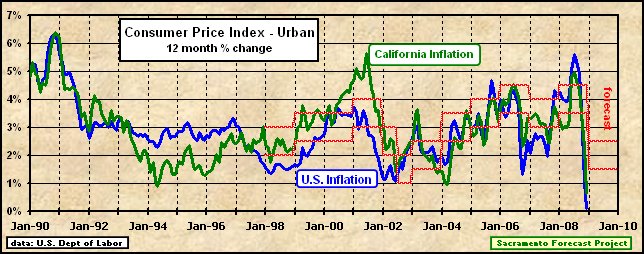
Inflation will remain tame for a forseable future without inflation shocks despite record high deficits. Why is this possible? Because the Chinese continue to buy our treasury bonds because they need somewhere to park their surplus, and they are also dependent on the United States to buy their goods. It’s this interdependency that allows the fed to print an arbitrary amount of money to prime the economy during recessions, without the associated risks of hyperinflation. During the 2002-2007 bull market the Bush administration ran up a large deficit to fund the Iraq war, but hyperinflation never ensues. Consumer prices rose, but not exceedingly so as you can see form the graph below:
Obama has plans to raise taxes on the top one percent of earners, but I doubt he’ll ever get around to doing so because rising taxes is a very unpopular political move. Also, an increase in federal taxes will have to eventually pass through the senate, where I’m certain it will fail. There will be no tax increases in the foreseeable future.
High tech innovation and free market capitalism is still alive and well. Silicon Valley internet companies such as Facebook, Myspace, Google, Twitter, are at the forefront the second dotcom boom under the moniker web 2.0. On the other hand, Apple and Research in Motion are leading the second incarnation smart phone/personal electrinic revolution. These companies are essentially immune to the recession,which is why facebook’s traffic continues to surge and why Apple, Google, and RIMM continue to beat earnings estimates.
The culmination of the above factors, and a gradual increase in consumer spending, household debt, manufacturing activity and the revival of the housing market will set the stage for many years of modest, steady GDP gains. These gains will be manifested in a long bull market very similar to the one between 2002-2007 with the same leadership. Don’t fall prey to the doom and gloomers in the mainstream media who keep dwelling on negativity regarding job loss and financial crisis. Instead, embrace the resurgence of the Goldilocks’s economy, and invest accordingly.
Just Keep Buying the Dips Part 2
Stocks were flat Last Friday and today. My advice is to keep buying all the dips. I expect that by the end of the week the markets will have surged three or more percent putting the dow above 8200.
It definitely appears the the media generated mental recession and fake financial crisis is coming to an end. The pimple faced Geitherner and ‘Ben the dog or doggy boy Ben’ Bernanke’s efforts to print money to improve investor confidence and free up liquidity seem to have worked given the slightly inproving economic numbers and massive rally in equties.
In addition, free market capitalism still prevails and there will be no hyperinflation, nor deflation. Just a perpetuation of consumerism, spendism, materialism, paymentism, globalism, smartism, and web 2.0. We need to keep spending more and saving less. Need to max out credit cards on gas and food which benefits Potash, Visa and Mastercard stock and attend college to become a tolerant, well educated citizen in a multicultural, globalist society. We need to open the borders! And we need to continue to insource (from Mexico) and outsource (India, China) labor because American labor is too expensive due to unnecessary workers compensation, pensions, disability pensions, nest eggs and stuff like that, which hurts profits.
Long: Google, Mastercard, potash Corporation